Do You Get Get Caught for Infrigment When You Download or Upload
At Allconnect, nosotros work to present quality information with editorial integrity. While this post may comprise offers from our partners, our opinions are our ain. Hither'south how we make money.
Inside 24 hours of airing, more than 71 million people had watched the premiere of the final season of Game of Thrones.
More than 75% of them did so through a pirated stream or download. For reference, that's 54 million people — around three million more than the population of Republic of korea.
"If you lot go around the globe, I think you're right, that Game of Thrones is the most pirated prove in the globe," Time Warner exec Jeff Bewkes said in 2013. "Now that's ameliorate than an Emmy."
Information technology's not just Game of Thrones. Stats on unlicensed streaming are hard to pin down, merely estimates range from 53% of millennials accessing illegal streams in one month to 78.v billion visits to piracy sites in 2015.
And with more and more (and more and more) streaming services entering the fray — and adding digits to TV bills — every calendar month, it'due south unlikely nosotros'll see a slowdown someday presently.
In fact, streaming accounts for lxxx% of piracy in the U.South. The Impacts of Digital Piracy on the U.S. Economy report past the Global Innovation Policy Centre estimates "that global online policy costs the U.Due south. economy at to the lowest degree $29.two billion in lost revenue each year."
The Protecting Lawful Streaming Act of 2020
In December 2020, Congress passed the Consolidated Appropriations Act of 2021. Within that, the Protecting Lawful Streaming Human action of 2020 (PLSA) increases criminal penalties for those who, on a large scale, "willfully and for commercial advantage or private financial gain, illegally stream copyrighted material. Previously, illegal streaming was treated equally a misdemeanor. Nether the new police force, the Department of Justice can bring felony charges confronting providers (every bit opposed to users) of such illegal services," according to the U.S. Patent and Trademark Office.
"The new law addresses a 'loophole' in criminal copyright police, under which infringing acts of reproduction or distribution triggered felony penalties yet infringing public performances (such as streaming) merely amounted to misdemeanors," reports the international law firm Perkins Cole on jdsupra.com.
Then what exactly constitutes illegal streaming? And what are the consequences?
(Major caveat: None of this should be taken as legal communication. We spoke with 4 copyright lawyers for this piece, and they all uttered some version of "it depends" during our interviews.)
These cases can be highly fact-specific, and we don't endorse watching pirated content under any circumstances. Our general rule of thumb: If paying for something volition pb to money in the pockets of the people who made information technology, you should probably pay for it.
As Jim Gibson, law professor and founder of the Intellectual Holding Institute at the University of Richmond School of Constabulary, put information technology to us: "Whether information technology'due south wrong or not, in a moral sense, is something you tin can ask your friends or your minister. Simply whether information technology's illegal from a copyright viewpoint, the best answer is, probably non on an private viewer basis."
Watching a stream of unlicensed movies, TV and sporting events is legal
Any word of the legality of streaming in the U.S. begins with the Copyright Human action of 1976. This grants copyright holders "exclusive rights" to brand copies of their work, distribute information technology and perform it publicly.
And watching a stream — fifty-fifty if it'southward unauthorized by the copyright holder — doesn't technically violate these rights. At that place accept been numerous challenges and interpretations as copyright police force has adapted to the cyberspace, but this reading has essentially held truthful.
The new PLSA constabulary "will not bear on the activities of ordinary cyberspace users. Nor would it criminalize good faith business/licensing disputes or noncommercial activities. This means that individual cyberspace streamers cannot exist subject to felony prosecution under the PLSA, for case by incorporating unauthorized content in a YouTube or Twitch stream. The normal practices of internet service providers (ISPs) would as well not be field of study to penalties under the PLSA, fifty-fifty when ISP users/subscribers misuse their services for purposes of infringement," according to the Copyright Alliance.
"I think the best interpretation of copyright law is that it's non illegal to watch unlicensed content," Gibson said. "The person who'southward merely watching a stream should incur no copyright liability from that act lonely."
Watching a stream doesn't constitute public performance
"Copyright attaches liability only to public performances, and streams aren't public performances," Gibson said. "Streams are performances, only they're not public if it's just you in the privacy of your own dwelling and you're not making a permanent copy — yous first it and yous terminate it and that's your only interaction with it."
Nicole Haff, partner and head of litigation at Romano Law PLLC, a firm focused on business, media, sports and amusement police force, agreed with this interpretation. "I think it would exist a difficult argument to say that somebody watching a streamed video is publicly performing the video," she said. "They're not the 1 putting information technology out at that place, they're actually receiving it."
"Pseudo-streaming" doesn't count every bit making a re-create
One of the near common arguments for unlicensed streaming violating copyright police force is that streams actually do create copies of the work in order to human action as a buffer and then your stream remains uninterrupted. This is technically known as a "progressive download," but more than commonly called "pseudo-streaming."
However, the pseudo-streaming argument hasn't held up in courtroom. "Copyright doesn't care most versions of the work that are and so transitory that they almost immediately disappear upon consumption," Gibson explained. "That's not a copy nether the law's definition."
The U.S. Copyright Function itself basically conceded the impossibility of pinning this bespeak downwardly in its 2001 report on the Digital Millennium Copyright Act: "How temporary is temporary? Hours? Minutes? Seconds? Nanoseconds? The line would be hard to draw, both in theory and as a thing of proof in litigation."
Information technology's highly open to estimation, and then far, those interpretations accept been that streaming does not equal making a re-create.
"The cases basically say, "That'southward not what we're talking about when we're talking virtually a permanent re-create,'" Gibson said. "If you're really doing existent-time streaming and no lasting, accessible copy ends up on your computer, then YouTube might be liable, and the original uploader might be liable, but the person watching the stream almost certainly is not."
Peer-to-peer streaming
There is one type of unauthorized streaming that could go yous into trouble: Peer-to-peer streaming services similar BitTorrent Alive. Like torrents, these services rely on users to share the content. If you're a viewer, you lot're also a broadcaster, which does violate copyright constabulary.
"If I access that stream via a peer-to-peer streaming service that I know is not legal considering I'thousand uploading unauthorized content in social club to access other unauthorized copies, so aye, I can arrive trouble for participating in streaming in that style," Joy Butler, attorney and author of The Permission Seeker's Guide Through the Legal Jungle, told us.
Just these types of peer-to-peer streaming networks aren't all that mutual right now, and you lot typically have to opt in by clicking "Permit" before joining a stream. It'due south unlikely that someone would unwittingly join one.
Downloading unlicensed content is always illegal
While streaming doesn't violate U.S. copyright law, downloading very explicitly does. You lot're making a copy of the work every time y'all download something — a clear violation if it'south done without the copyright holder'due south permission.
"The copyright possessor has the sectional right to make copies. That's why nosotros call it the 'copyright,'" Gibson explained. "So if you're making a copy that is some sort of permanent version of a work, and so even if you do information technology in the privacy of your own home, you may well be liable."
That said, while there's no debate on whether or non it's illegal to download unlicensed content, ordinary users are unlikely to face legal consequences.
"I remember in about cases, the copyright owner's going to want to pursue the person who'southward actually uploading the content," Butler said. "In the music industry, pursuing individual listeners to content was not very effective and it was not very popular from a P.R. standpoint."
Gibson echoed those comments, telling us, "At that place was a fourth dimension when the recording industry and to some extent, the film industry, was actually targeting those who but downloaded illegally for their own enjoyment. Simply they basically haven't been doing that for a expert eight or ix years."
"This is not to say information technology'southward OK to do. If you download, you are very likely infringing copyright and shouldn't practice information technology. Merely your practical likelihood of getting sued is pretty depression if you're just an individual downloading for your own consumption"
Hosting an unauthorized stream is illegal
While watching an unauthorized stream is legal, hosting 1 is not — and it'south much more than likely to depict attending from copyright holders.
"What they actually want to know is who's putting the content out there. Because that's the bigger fish to fry," Haff said. "So many Americans illegally stream, you lot would be in endless litigation."
Hosting an unauthorized stream falls under the distribution portion of the Copyright Act, but the criminal penalties are limited to misdemeanors, as opposed to felonies for downloading.
"The maximum penalty is substantially a twelvemonth in prison and a $100,000 fine — or twice the monetary proceeds or loss," Haff said.
In the past, the authorities has attempted to make penalties for hosting illegal streams more commensurate with downloading. In 2011, the Commercial Felony Streaming Act was introduced to the Senate. Information technology would take fabricated hosting illegal streams for the purpose of "commercial advantage or personal financial gain" a felony with upward to five years in prison house.
The bill faced significant backlash from the public, nearly notably from streamers on YouTube. In that location was even a "Gratis Bieber" campaign started by the pop singer'southward fans, who worried that the covers of copyrighted songs that launched his career could put him behind confined if the neb passed.
Ultimately, that outcry was enough; the bill was never even voted on. Today, hosting an unauthorized stream remains a misdemeanor in the U.S., although civil damages are more probable in most cases.
Copyright enforcement is nearly ever civil, not criminal
While there are harsh penalties in place for illegal streaming and downloading, you lot're much more likely to face activeness from the copyright holders themselves than the government.
"The vast, vast majority of copyright enforcement is civil," Gibson told us. "At that place'southward a very small number of criminal copyright prosecutions each year. I call back the number'due south probably effectually 100. They tend to be confronting large-scale, commercial piracy operations."
"I've never heard of a criminal prosecution for personal apply downloading, infringing though information technology might be. So that big FBI alert, information technology's mostly just to scare people rather than nowadays them with a realistic scenario of what might happen."
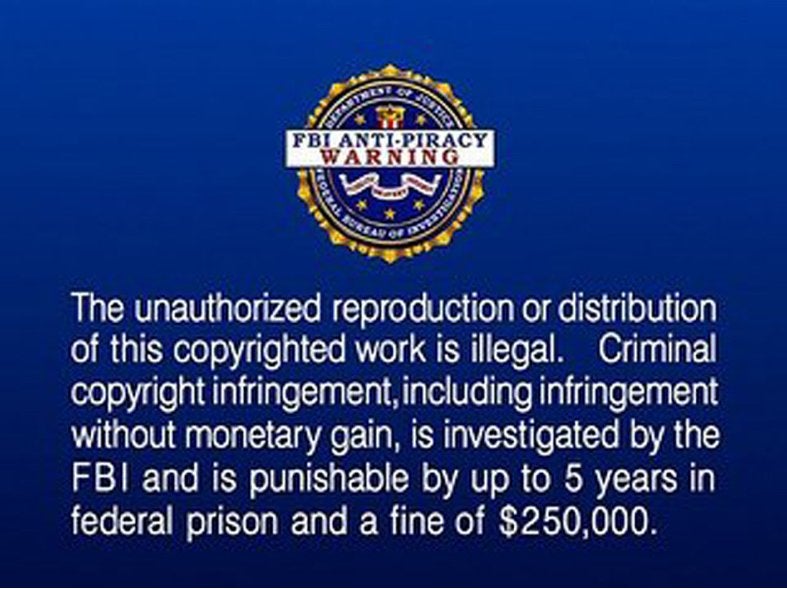
FBI warning
Image credit: The Hollywood Reporter
Fifty-fifty if streaming is legal, viruses are even so a concern
For many people, computer viruses from less-than-reputable streaming sites are as stiff a deterrent as legal action. If a site is willing to break the law to host pirated content, it'due south fair to assume that information technology won't end at that place.
Hither'due south what the Federal Merchandise Commission says on the topic: "Purveyors of pirated content are now spreading apps and add together-ons that work with popular streaming devices. If you download one of these illegal pirate apps or add together-ons, the chances are expert that you'll also download malware."
That's not necessarily as alarmist as information technology might sound. According to a 2015 report past the non-profit Digital Citizens Brotherhood, about one-tertiary of illegal streaming sites exposed users to malware. The report estimates that these sites make around $70 million per year this way.
"It's articulate that the criminals who exploit stolen content have diversified to make more money by baiting consumers to view videos and songs and then stealing their IDs and financial data," said Tom Galvin, Executive Manager of the Digital Citizens Alliance.
Post-obit all-time practices for net safe can become a long way in protecting you lot from malware, only using illegal streaming sites volition ever present a significant run a risk.
The bottom line
If you're simply watching a stream of unlicensed content, you're non technically breaking the law. Where it becomes a crime is if you download the movie or show, or host a stream yourself.
The PLSA police is going subsequently the big fish – the services that stream pirated content.
But just because y'all can doesn't mean you should. You are taking away rightful profits from someone else's work.
We liked the fashion Jim Gibson put information technology to us: "The fact that something'southward legal or the fact that something'southward illegal but unlikely to result in a lawsuit, doesn't necessarily tell the states what'south right and wrong. People accept to accept their own moral compass about the kind of acquit in which they engage when it comes to copyrighted works."


Written by:
Joe SupanSenior Writer, Broadband Content
Joe Supan is a senior author for Allconnect. He has helped build the proprietary metrics used on Allconnect'south review pages, utilizing thousands of data points to help readers navigate these complex decisions. … Read more 


Edited by:
Trey PaulEditor, Head of Content
Read bio
-
All you lot demand to know about streaming Television — A beginner'southward guide Joe Supan — 6 min read
-
A beginner'south guide to streaming on Twitch Joe Supan — 5 min read
Source: https://www.allconnect.com/blog/is-streaming-illegal
0 Response to "Do You Get Get Caught for Infrigment When You Download or Upload"
Post a Comment